Byzantine time
How long since sunset?
Equal sixty-minute hours, counted from local sunset.
Web app · byzantine.live
The time of a day that begins at sunset, calculated for where you are.
A web app that shows Byzantine time, seasonal hours and civil time, the day’s offices, limited Orthodox calendar calculations and prayers. The calculations run in your browser.
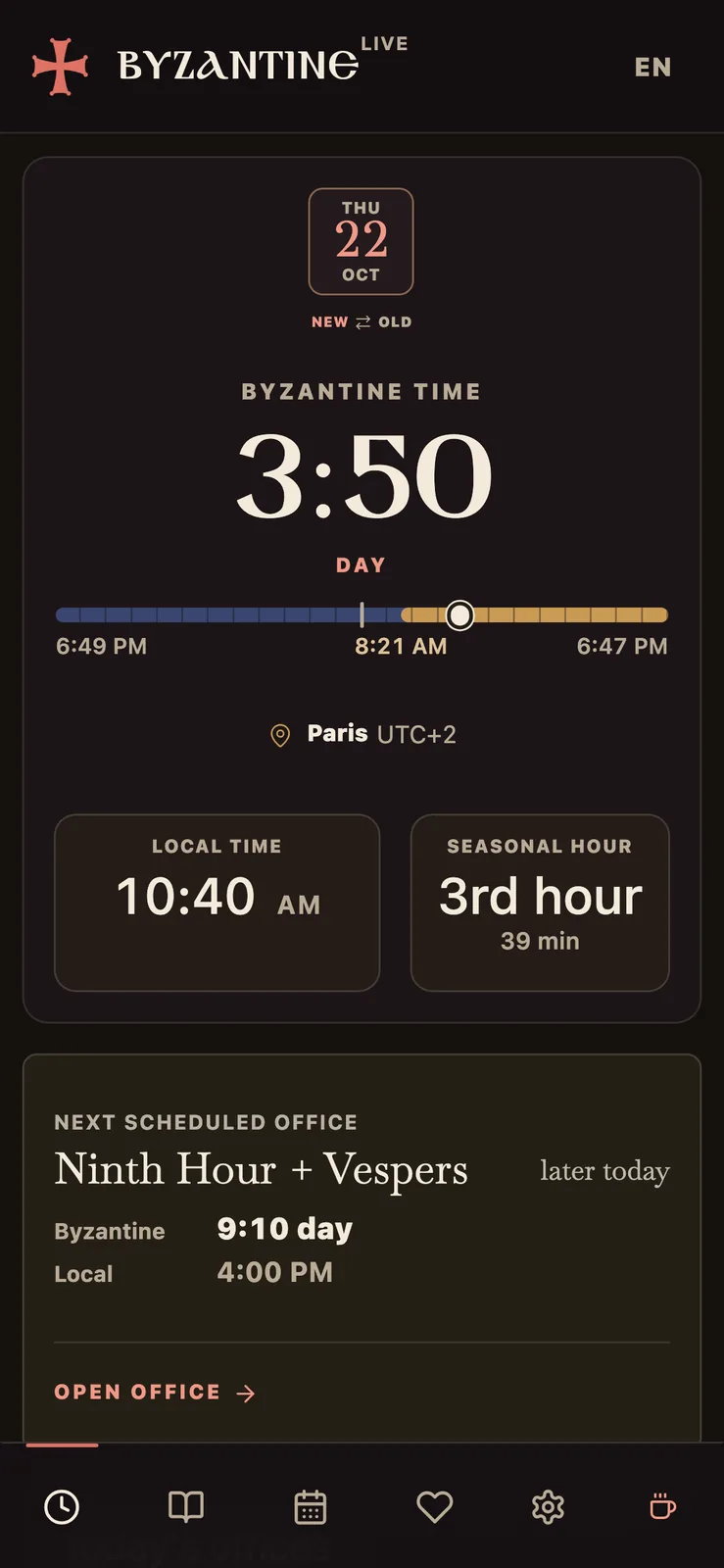
The idea
In Byzantine reckoning, still used on Mount Athos, the clock is set back to 12:00 at sunset. It then counts twelve hours of night and twelve hours of day, each sixty minutes long.
Sunset moves through the year, so Byzantine time drifts against civil time, and sunrise does not always fall at the same Byzantine hour. The app sets three readings side by side.
Twenty-four equal hours, from one sunset to the next; daylight, in gold, moves across them through the year.
How long since sunset?
Equal sixty-minute hours, counted from local sunset.
Where are we in the light?
Day and night are each divided into twelve unequal hours. In summer: 15 h of daylight ÷ 12 = 75 minutes, 9 h of night ÷ 12 = 45 minutes.
What time does the zone share?
The ordinary time of the chosen place and time zone, kept beside the other two.
What it does
Around the clock, the app gathers what is set by it. Every image below is an actual capture of the site.
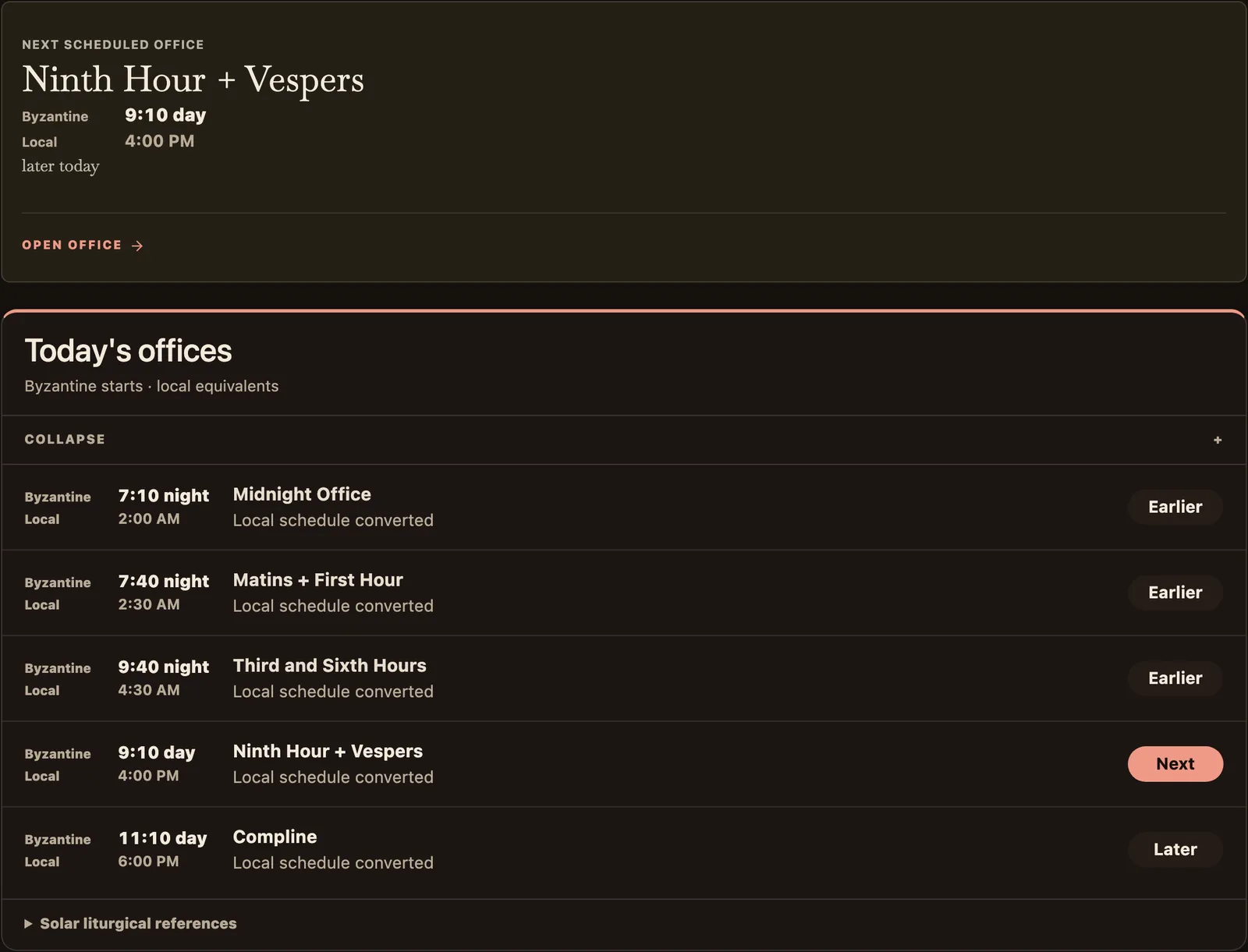
Midnight Office, Matins and First Hour, Third and Sixth Hours, Ninth Hour and Vespers, Compline: each block gives its start in Byzantine time and its local equivalent, and the next office is brought forward.
These five blocks are an application convention informed by published monastic rhythms. They are not an official or universal timetable.
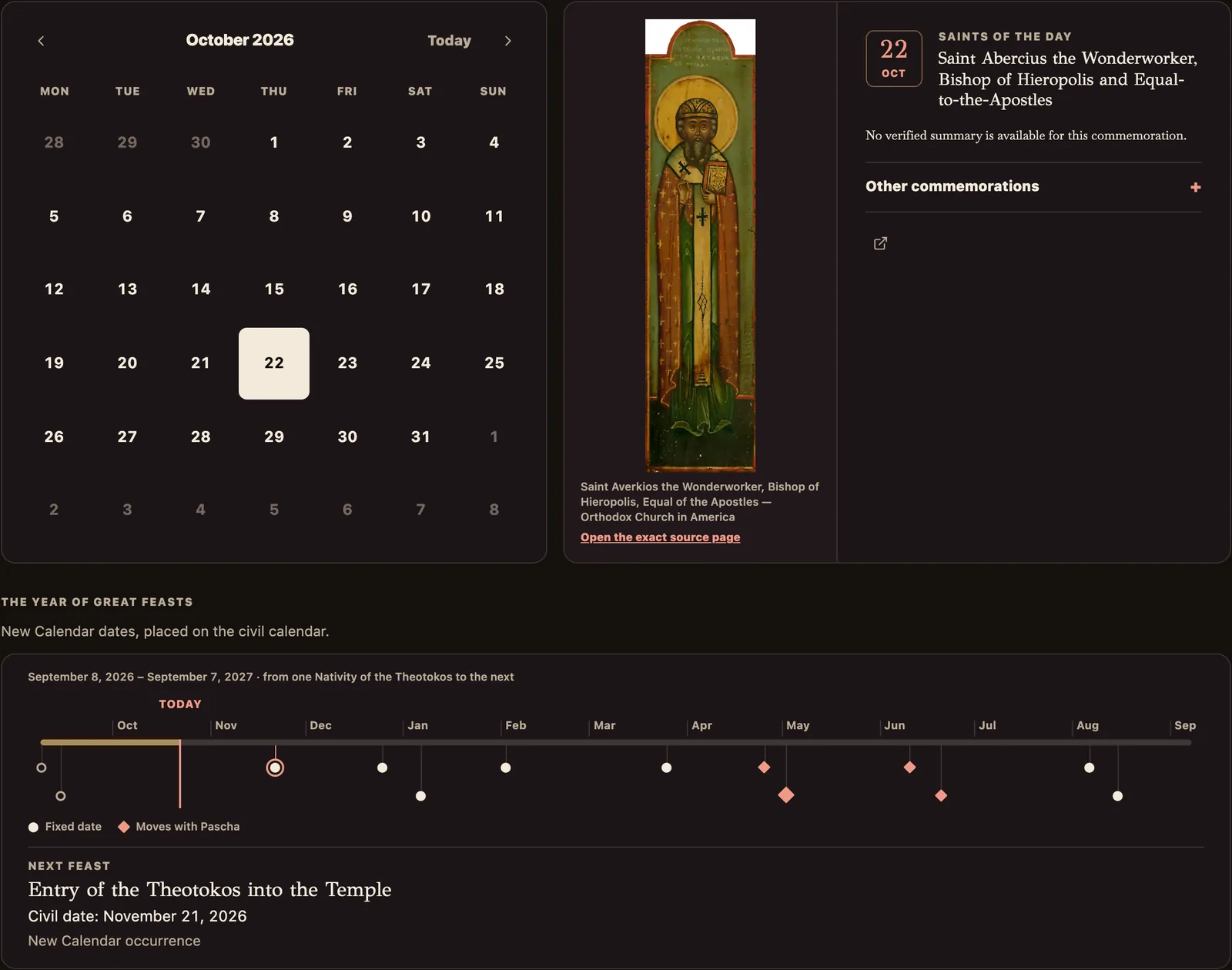
Two convenience profiles: Generic Old Calendar and Generic New Calendar. They give the saints of the day, the year of great feasts and the date of Pascha, calculated with Alexandrian-Julian ecclesiastical arithmetic rather than from an observed full moon.
Settings also offer bounded content choices (GOARCH Revised Julian 2026; Moscow Patriarchate Julian 2026). None is a complete jurisdiction profile.
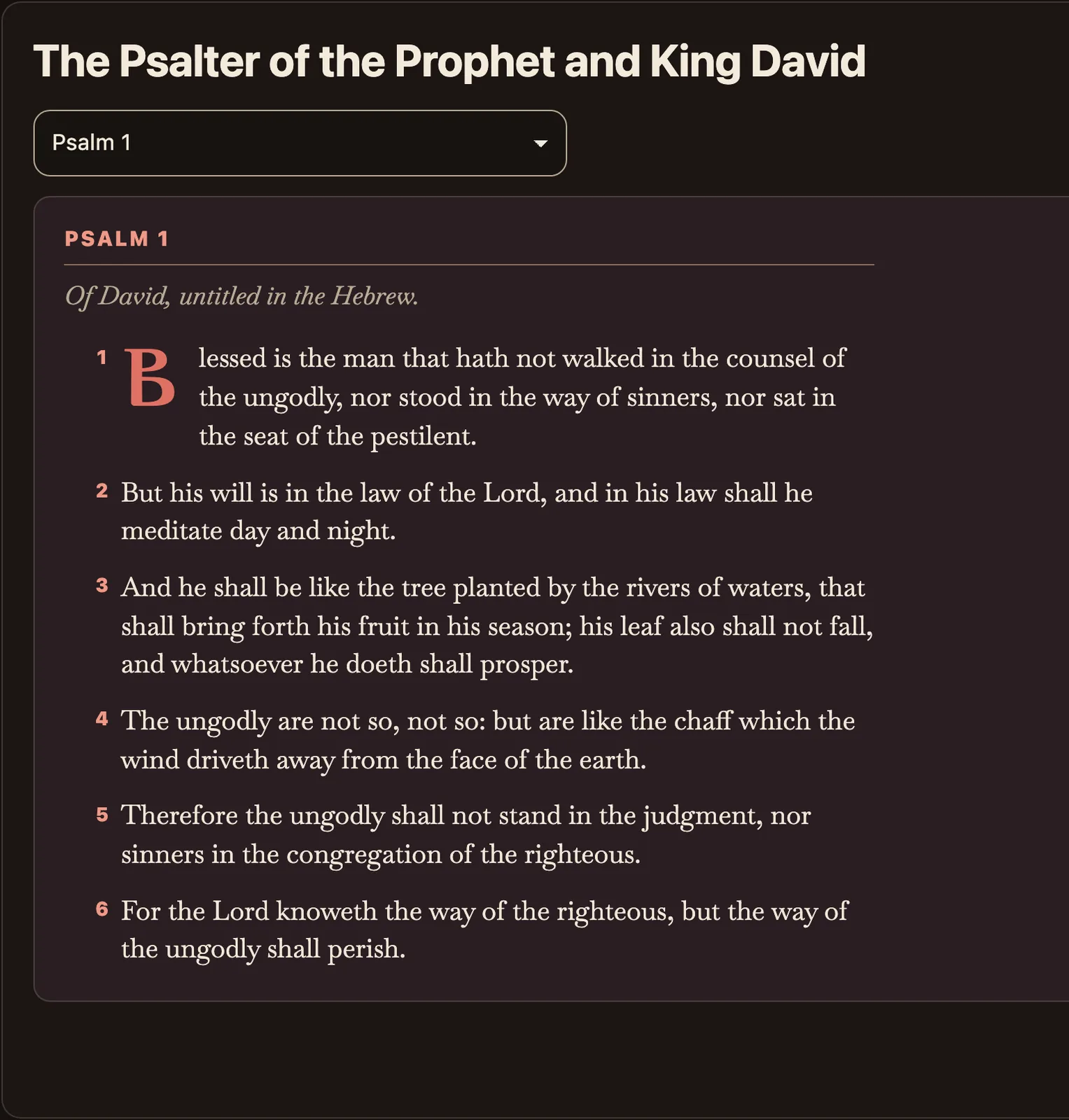
Usual prayers, the penitential psalms, prayers to the Mother of God, and the Psalter, with its weekly distribution into kathismata for the morning office and Vespers.
Every liturgical source is listed with its rights status: public access is not treated as permission.
They work while the page stays open and active. For later alerts, download a calendar file and let your calendar app handle notifications.
Export creates a bounded .ics file that common calendar apps can open. Import shows events in the browser session, without changing the clock, profile, location, calendar rules or office schedule.
English, French, Greek and Russian. The app opens in the browser, on a phone or a computer.
Limits and privacy
Byzantine hours helps you calculate, on your device, Byzantine time and some calendar dates. It is not an ecclesiastical authority, nor an official Athonite, parish, monastery, diocesan or jurisdictional calendar.
Origin
The clock was made after reading a passage about Saint Porphyrios of Kavsokalyvia (1906–1991), which its author understood as a wish for an exact Byzantine-time clock. It is a small calculation aid inspired by that memory, not an official Athonite or ecclesiastical clock.
Reference cited by the app: Klitos Ioannidis, Elder Porphyrios: Testimonies and Experiences.
Byzantine hours is designed and built by Dasti.